

Most maritime companies can now say they're "using AI". That's the easy part, and not the part that pays off. The real work is changing how the organisation itself operates.
There's a comfortable story going around maritime procurement. You pilot an AI tool, roll it out, tick the box, and your company is "doing AI". It's an understandable story, and it's wrong.
"Implementation is not adoption," as Closelink founder and CEO Philippe put it in his keynote at IMPA 2026. Rolling out a tool doesn't mean people are really using it. And even real adoption isn't the finish line. The companies that get ahead are the ones that adapt: they change how they work around what AI makes possible. With AI moving as fast as it is, the gap between those three steps is getting wider.
In the last two articles we looked at what lubricant procurement could look like in 2030, and at the four stages the technology goes through to get there. But the technology is only half the equation. The other half is whether an organisation can take in the change. "You need to make a distinction between what AI can do and what your organisation is able to conduct right now and to absorb," Philippe said. Most companies underestimate how far apart those two things are.
What the research says
MIT's Center for Information Systems Research (CISR) has put numbers on this gap. Its Enterprise AI Maturity Model, published in December 2024, places companies in four stages (MIT Sloan):
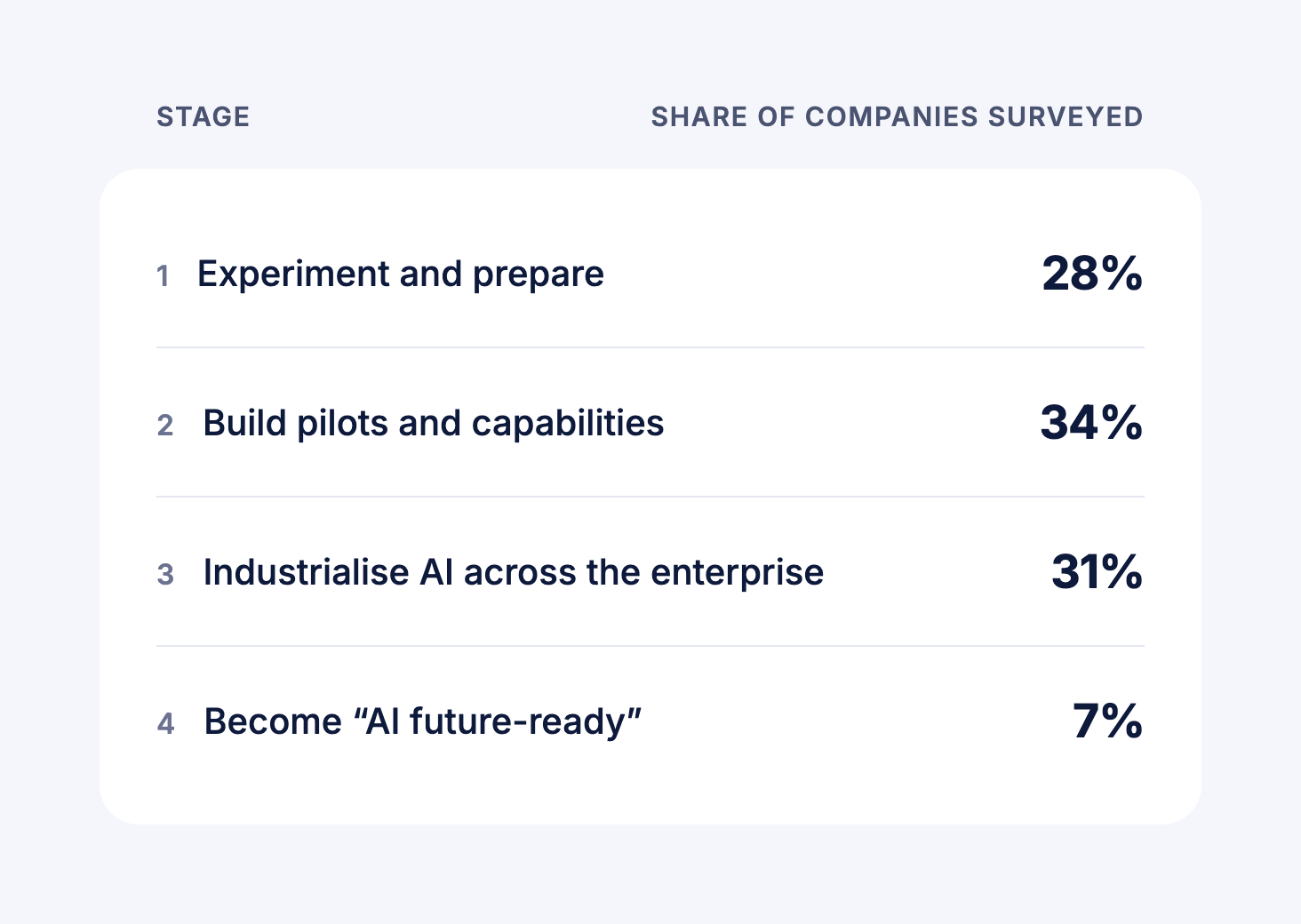
The most important finding is financial. Companies in the first two stages performed below their industry's average. Companies in stages three and four performed above it. AI maturity isn't an IT metric. It shows up in business results.
The cycle also repeats. Each time the technology takes a step forward, from assisting to advising or from acting to coordinating, organisations go back through exploring, piloting and embedding. Maturity isn't something you reach once. It's something you keep working at.
Most of maritime is still exploring
Most maritime procurement teams are at the first stage today. They're talking to consultancies and software providers and asking what AI could do for them. That's the right start, as long as it leads somewhere.
Moving forward means choosing one clearly defined problem, such as matching an invoice to a purchase order, and proving it's worth doing. A pilot that can't show value it can repeat isn't a first step. It's a detour.
Capability is about people
In our view, the most underrated part of AI maturity isn't software. It's people. "You need to get your workforce on board," Philippe said. "They need to be trained. They need to get a better understanding. They need to be able to make mistakes and learn from it."
That last point matters a lot in procurement, where one mistake can leave a vessel without the oil it needs. The natural reaction is to lock things down. But teams that are never allowed to experiment won't build the judgement they'll need to supervise AI once it starts acting on its own. Room to learn safely isn't a luxury. It's a requirement.
The hard part: adaptation
Once a pilot works, the next step is adoption: go live, embed it and make it part of how work gets done. This is where many companies stop, and where the real problem starts.
Take an AI bot that clicks through your ERP system on someone's behalf. It can be a sensible first step. It frees up time and teaches the organisation something. But it automates a process designed for people, and keeps every limit that process was built around. "The biggest challenge will be to allow adaptation within your organisation," Philippe said, "to eventually challenge existing processes, challenge existing ERP systems or whatever, and be bold enough to make a change."
In lubricant procurement, real adaptation looks like this:
- Measuring different things. Moving from unit price per litre to the total cost of keeping equipment running, so a cheap oil that increases wear no longer counts as a saving.
- Redesigning approvals. Many approval chains exist because quotes used to be gathered and compared by hand. If AI orders within agreed rules, people should approve exceptions, not every order.
- Sharing data with suppliers. Sharing demand forecasts instead of guarding them, so suppliers can plan production and regional stock, and emergency deliveries fall.
- Redefining the role. Moving from buyer to supply manager, with time spent on analysis, supplier relationships and negotiation instead of chasing quotes.
None of these is a software installation. They're decisions about how the company works, and that's exactly why they're hard, and why they separate the leaders from everyone else.
Waiting costs more
It's tempting to wait for the technology to settle down before committing. That's the expensive choice. AI has changed the pace of change itself, and in Philippe's words, "the later you come entering the party, the higher the compounding cost of adapting to it" becomes. Capabilities, clean data and trust inside the organisation all take time to build. Competitors who start now aren't standing still while others wait.
Where to start
The question isn't whether your company is using AI. It's whether AI is changing how your company works. Adoption puts the tools into daily use. Adaptation is what makes them pay off. Pick one well-defined problem, prove its value, invest in your people, and then be willing to question the processes that problem sits inside.
